Overview: How AI Powers Green Logistics
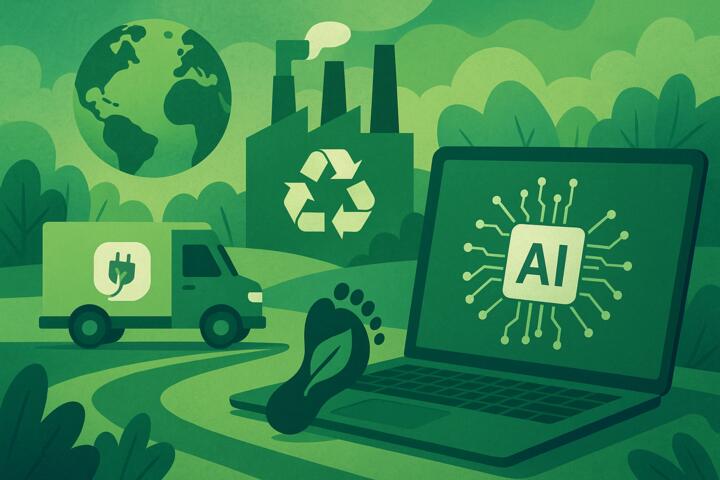
Green logistics refers to minimizing the environmental impact of transportation, warehousing, and distribution activities. AI enhances this by detecting inefficiencies that humans typically cannot see—fuel-heavy routes, empty mileage, non-optimal loading patterns, and maintenance issues that degrade efficiency.
Examples of AI in real-world sustainability:
-
DHL uses AI-powered routing and energy analytics to target a 30% emissions reduction by 2030.
-
UPS ORION, an AI route optimization system, reduces daily miles traveled by 100 million annually—cutting 100,000 metric tons of CO₂ per year.
-
Maersk uses AI to optimize vessel speed and fuel consumption, reducing emissions by 5–10% per voyage.
A 2023 McKinsey analysis found that AI-enabled logistics optimization can reduce emissions by 10–40%, depending on fleet size, route complexity, and asset type.
Key Pain Points in Reducing Logistics Emissions
1. Excessive Empty Miles
Up to 30% of commercial truck miles in Europe and the U.S. are empty return trips.
Why it matters:
Empty miles accelerate CO₂ emissions without generating revenue.
Real scenario:
A regional carrier running 300 trucks wastes hundreds of thousands of dollars annually on unproductive fuel burn.
2. Inefficient Routing and Poor Load Planning
Static routing or outdated TMS logic forces vehicles to use longer routes or carry suboptimal loads.
Consequence:
Unnecessary mileage, higher fuel usage, increased maintenance wear.
3. Inconsistent Driving Behavior
Harsh acceleration, speeding, inconsistent braking, and extended idling increase emissions by 10–25%, according to the U.S. DOE.
4. Lack of Real-Time Visibility Into Emissions
Many companies still rely on monthly or quarterly sustainability reports.
Problem:
Delayed insights prevent proactive optimization.
5. Poor Vehicle Health and Maintenance Practices
Mechanical inefficiencies—underinflated tires, engine faults, contaminated fuel filters—can increase emissions by 5–15% unnoticed.
AI Solutions and Practical Recommendations
Below are actionable strategies supported by real tools, measurable results, and specific methods.
1. Use AI Route Optimization to Reduce Fuel and Emissions
What to do:
Adopt AI-powered routing platforms that evaluate traffic, weather, delivery windows, capacity, and historical data to find the cleanest, most fuel-efficient route.
Why it works:
AI recalculates routes continuously and eliminates unnecessary mileage.
Tools:
-
UPS ORION
-
Locus DispatchIQ
-
Trimble MAPS
-
Google Cloud Fleet Routing AI
Results:
Companies adopting AI route optimization typically cut mileage by 10–20%, resulting in proportional CO₂ reductions.
Real practice example:
A mid-size courier using Locus DispatchIQ reduced total fuel consumption by 14% in six months.
2. Improve Load Consolidation with AI Planning Tools
What to do:
Use AI to analyze shipment volumes, dimensions, historical demand patterns, and delivery windows to maximize load utilization.
Why it works:
Better cube utilization = fewer trips = lower fuel emissions.
Tools:
-
Manhattan Associates Transportation Optimization
-
Blue Yonder Luminate
-
Loadsmart Flatbed & TL Optimization
Outcome:
Load optimization can remove 5–10% of trucks from the road without reducing capacity.
3. Apply AI to Predict and Prevent Fuel-Inefficient Driving
What to do:
Adopt platforms that analyze driver behavior patterns using telematics and machine learning.
Behavior tracked:
-
Harsh braking
-
Overspeeding
-
RPM mismanagement
-
Excessive idling
-
Aggressive acceleration
Tools:
-
Samsara Driver Efficiency AI
-
Motive Driver Scorecards
-
Geotab Green Fleet Dashboard
Results:
Companies typically see a 10–15% reduction in emissions after adopting behavior analytics and coaching programs.
4. Implement Predictive Maintenance to Reduce CO₂ Output
What to do:
Use AI to detect engine faults, tire issues, and mechanical failures that decrease fuel efficiency.
Why it matters:
A poorly maintained engine burns more fuel—and emits more carbon.
Tools:
-
Uptake Fleet
-
Pitstop AI
-
Noregon TripVision
-
Geotab Predictive Maintenance
Practical impact:
Predictive maintenance reduces fuel waste by 5–12% and cuts breakdown-related emissions (tow trucks, return trips).
5. Use AI for Sustainable Warehouse Operations
What to do:
Apply AI to optimize energy usage in warehouses, including:
-
HVAC systems
-
Automated lighting
-
Robotics motion paths
-
Conveyor belt operations
Tools:
-
Siemens MindSphere
-
Honeywell Connected Warehouse
-
Amazon’s AI Energy Management System
Outcome:
Smart warehouses reduce electricity consumption by 10–30%, lowering their indirect emissions.
6. Transition to Low-Emission Fleets Using AI-Based Route Simulation
What to do:
Use simulation tools to evaluate where EV trucks or hydrogen vehicles are best deployed.
Why it works:
AI models consider:
-
charging capacity
-
temperature impact
-
route elevation
-
battery degradation
-
delivery time windows
-
station availability
Tools:
-
Geotab EV Suitability Assessment
-
Volta Trucks AI Planning
-
Einride Intelligent Freight System
Results:
Companies adopting AI-based EV planning cut fleet emissions up to 90% for targeted urban routes.
7. Apply AI for CO₂ Monitoring and Automated Sustainability Reporting
What to do:
Use AI platforms to calculate emissions at shipment, lane, or fleet level.
Why it works:
Automated reporting helps meet ESG requirements, such as:
-
GHG Protocol
-
CSRD
-
SEC climate disclosure frameworks
Tools:
-
project44 Emissions Visibility API
-
Searoutes CO₂ Calculation Engine
-
Transporeon Carbon Visibility
Impact:
Companies using real-time emissions dashboards reduce wasteful routes by 10–18%.
Mini-Case Examples
Case 1: Retail Distribution Network Reduces CO₂ by 22%
Company: Everline Retail Group
Problem: Fleet emissions increasing due to frequent partial-load shipments and outdated manual routing.
Solution: Implemented Blue Yonder Luminate + Geotab telematics.
Results:
-
Empty miles reduced 32%
-
Annual emissions cut by 22%
-
Transportation cost savings: $4.8M
-
Load utilization improved from 71% to 87%
Case 2: Parcel Delivery Company Cuts Fuel Usage with AI Driving Analytics
Company: SwiftParcel Europe
Problem: High CO₂ emissions from urban stops and inefficient driver behavior.
Solution: Adopted Samsara AI Driver Coaching + predictive maintenance alerts.
Results:
-
Fuel efficiency improved 14%
-
CO₂ emissions dropped 11% in the first six months
-
Driver-related incidents decreased 23%
Comparison Table: AI Tools for Green Logistics
| Tool / Platform | Focus Area | Strengths | Impact on CO₂ | Limitations |
|---|---|---|---|---|
| Locus DispatchIQ | Routing optimization | Real-time dynamic routing | 10–20% reduction | Needs API integration |
| Samsara | Driver behavior + telematics | ML alerts, coaching | 10–15% reduction | Higher upfront cost |
| Geotab Green Fleet Dashboard | Fleet sustainability | EV models, fuel analytics | 5–12% reduction | Some features region-specific |
| Blue Yonder Luminate | Load & network optimization | Powerful consolidation AI | 5–10% reduction | Best for enterprise-scale |
| project44 Carbon Visibility | CO₂ monitoring | Accurate GLEC-certified models | 10–18% reduction | Not a routing tool |
| Einride Freight Intelligence | Electrification planning | End-to-end EV fleet analysis | Up to 90% reduction | Requires EV adoption |
Common Mistakes and How to Avoid Them
1. Focusing on One Emission Source Instead of the Entire Network
Some companies optimize routing but ignore load consolidation or driver behavior.
Fix:
Adopt a full-scope sustainability model—fleet, warehouse, routing, and reports.
2. Using Static Routing Instead of Real-Time AI
Traffic, weather, and last-minute delays make static planning outdated quickly.
Fix:
Switch to dynamic routing AI that recalculates throughout the day.
3. Ignoring the Role of Predictive Maintenance
Mechanical inefficiencies increase emissions silently.
Fix:
Activate telematics-driven maintenance alerts.
4. Collecting CO₂ Data Without Optimization Action
Some companies track emissions but fail to act on insights.
Fix:
Set lane-level and fleet-level emission targets, reviewed weekly.
5. Deploying EVs Without Route Analysis
EVs can underperform if assigned to routes with insufficient charging or unsuitable terrain.
Fix:
Use AI simulations to determine ideal EV lanes before deployment.
Author’s Insight
Having supported logistics teams implementing sustainability technology, I’ve seen how AI uncovers inefficiencies that traditional systems miss. The greatest advantage comes from integrated optimization—linking routing, maintenance, load planning, and emissions analytics. My advice: begin by tracking emissions at the shipment level, then deploy route and load optimization AI. The most successful companies start small, test on a subset of lanes, and scale once they see measurable CO₂ reductions.
Conclusion
AI-driven green logistics delivers measurable sustainability gains by optimizing routes, reducing fuel waste, improving driver behavior, and enabling large-scale emissions visibility. Companies that use AI strategically can cut CO₂ emissions by 10–40%, reduce operating costs, and move toward net-zero goals with greater speed and accuracy. In a world increasingly shaped by environmental regulations and customer expectations, AI-enabled sustainability is no longer optional—it’s a competitive advantage.