Advanced Logistics Logic
Traditional monitoring relies on "passive" thermal data—simple thermometers that record a breach after it has already happened. An AI-based system, however, uses predictive analytics to anticipate a failure before it occurs. For instance, if an onboard sensor detects a slight but steady rise in compressor vibration, the AI can flag a potential mechanical failure three days before the cooling unit actually stops working.
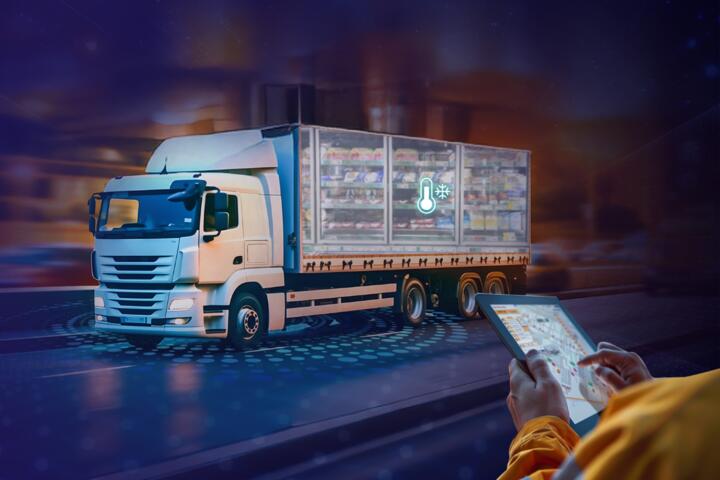
In practice, this involves a "Digital Twin" approach. Companies like Maersk or DHL create a virtual replica of the cargo container. By feeding real-time data from sensors (temperature, humidity, light, and CO2) into a neural network, the system can simulate how external factors—like a heatwave in the Port of Singapore or a 4-hour customs delay—will affect the internal shelf life of the product. Research shows that AI-optimized routes can extend the sellable life of produce by up to 15%.
Predictive Temperature Drift
Unlike static alerts, AI identifies "drift" patterns. It distinguishes between a temporary door opening and a gradual insulation failure. By analyzing historical data from thousands of shipments, platforms like Microsoft Azure IoT Central can predict temperature breaches with 90% accuracy, allowing drivers to adjust settings or seek maintenance before the cargo is compromised.
Dynamic Route Optimization
Weather and traffic aren't just inconveniences; they are thermal risks. AI engines integrated with Google Maps Platform and IBM Environmental Intelligence Suite calculate the most "thermally stable" route. If a mountain pass is experiencing record highs, the system reroutes the truck through a cooler, albeit slightly longer, path to minimize the strain on the refrigeration unit.
Automated Compliance Audits
Regulatory bodies like the FDA (FSMA Rule) require rigorous documentation. AI-based systems automate the "Chain of Custody" reporting. By using Computer Vision at checkpoints, the system can automatically log the condition of pallets, cross-referencing visual damage with sensor data to generate a tamper-proof audit trail without human error.
Energy Consumption Tuning
Cooling is expensive. AI algorithms analyze the specific thermal inertia of different cargo types (e.g., frozen fish vs. chilled berries). Systems like Carrier’s Lynx platform optimize the refrigeration cycle, cycling the compressor only when necessary, which can lead to a 20% reduction in fuel consumption for reefer units.
Shelf-Life Prediction
Not all "good" products are equal. Using the Arrhenius equation integrated into ML models, the system calculates the "remaining shelf life" (RSL) based on real-time exposure. If a batch of vaccines was exposed to +2°C above the limit for an hour, the AI recalculates its expiration date, enabling "First-Expired-First-Out" (FEFO) inventory management.
Cold Chain Vulnerabilities
The "Silent Failure" is the primary enemy. In 2024, it was estimated that 25% of all vaccines reach their destination with some degree of degradation because of brief, unrecorded spikes. Human error during "last-mile" delivery accounts for nearly 40% of these excursions. Without AI, these errors are invisible until the product fails to work or makes someone ill.
Furthermore, "Data Silos" prevent effective scaling. If the sensor data lives on a local logger and the truck’s GPS lives in a separate portal, there is no context. A temperature spike is just a number. Without AI to correlate that spike with a specific location (e.g., a sunny loading dock), managers cannot fix the root cause, leading to repetitive, expensive losses year after year.
Predictive Solutions
To implement an elite system, start with "Hardware-Agnostic" software. Using platforms like AWS IoT Core allows you to ingest data from various sensor brands (Nordic ID, Tive, or Roambee). This flexibility prevents vendor lock-in and allows you to scale the infrastructure as your fleet grows. Real-time data streaming via MQTT protocols ensures that even low-bandwidth connections in remote areas can transmit vital telemetry.
Next, deploy Edge AI. Processing data on the sensor itself (using TinyML) reduces latency. Instead of sending raw data to the cloud every second—which kills battery life—the device only transmits when it detects an anomaly. This extends sensor battery life from 6 months to 2 years, significantly lowering the total cost of ownership (TCO) for large-scale deployments.
Finally, integrate Blockchain for trust. Combining AI predictions with a decentralized ledger ensures that once a temperature breach is recorded, it cannot be erased. This is critical for high-value logistics, such as biologics or premium seafood, where insurance claims depend on irrefutable evidence of the storage conditions throughout the entire journey.
Real-World AI Success
A global pharmaceutical giant faced 12% product loss during transcontinental air freight. They implemented an AI solution using Schneider Electric’s EcoStruxure platform paired with cellular IoT trackers. The AI analyzed external airport temperatures and aircraft cargo hold patterns. Result: They reduced excursions by 85% and saved an estimated $2.4 million in its first year of operation.
A major European grocery chain used AI-driven shelf-life prediction for soft fruits. By shifting from a standard "Use By" date to an AI-calculated "Dynamic Freshness" score, they reduced in-store food waste by 22%. The system allowed them to discount products exactly when their real quality began to dip, rather than throwing them away based on a conservative, static date.
Monitoring Tech Comparison
| Feature | Legacy Data Loggers | AI-Powered Systems |
|---|---|---|
| Response Mode | Reactive (Post-Mortem) | Proactive (Predictive) |
| Data Insight | Simple Min/Max Charts | Digital Twin & Drift Analysis |
| Connectivity | USB / Manual Download | Real-time (5G/LTE-M/Sat) |
| Decision Making | Human-led | Automated / AI-Assisted |
| Waste Reduction | Minimal | Significant (15-30%) |
Avoiding Implementation Gaps
Avoid the "False Alert" trap. If your AI is too sensitive, it will bombard drivers with notifications for every 0.1-degree fluctuation. This leads to "alarm fatigue," where users eventually ignore the system. Use "Confidence Scoring" in your ML models—only alert the human operator when the probability of a genuine breach exceeds 95%.
Don't neglect the "Last Mile" hardware. While long-haul trucks are often well-equipped, the small vans delivering to pharmacies or homes are the weakest link. Ensure your AI platform supports mobile app integration, allowing gig-economy drivers to use their smartphone’s Bluetooth to sync with pallet sensors, maintaining visibility until the final handover.
FAQ
How does AI lower insurance premiums?
Insurers like Munich Re offer lower rates to companies using AI monitoring because the "Probable Maximum Loss" is lower. The ability to intervene and save a shipment mid-transit changes the risk profile from "uncontrollable" to "managed."
Can AI monitor cryogenic temperatures?
Yes. Specialized sensors for liquid nitrogen (-196°C) can be integrated into AI platforms. The AI helps by monitoring the boil-off rate and predicting when a refill is needed based on ambient temperature and vacuum seal integrity.
Is AI monitoring too expensive for SMEs?
No. With the rise of SaaS (Software as a Service) models, SMEs can pay "per shipment." Tools like Tive or Controlant provide the hardware and the AI dashboard as a combined service, removing the need for heavy upfront capital expenditure.
How does AI handle "Light Sensitivity"?
AI monitors light sensors to detect unauthorized container openings (theft or tampering). By correlating light spikes with GPS coordinates, the AI can immediately alert security if a container is opened outside of a designated geo-fenced warehouse.
Will AI replace human logistics managers?
It acts as a co-pilot. AI handles the "noise" of thousands of data points, allowing managers to focus only on the shipments that actually require intervention. It increases the "span of control" for a single manager from 50 shipments to 500.
Author’s Insight
I’ve seen dozens of companies buy expensive sensors only to use them as "glorified thermometers." The true ROI of a cold chain isn't in the hardware; it’s in the data orchestration. My rule of thumb: if your system isn't telling you what *will* happen in the next 4 hours, it's already obsolete. Focus on building a system that talks to your ERP—when the AI predicts a failure, it should automatically trigger a replacement order or notify the customer before they even realize there’s a problem.
Conclusion
AI-based cold chain monitoring is the only way to eliminate the inherent unpredictability of global logistics. By combining real-time IoT telemetry with predictive modeling, businesses can transform their supply chain from a cost center into a competitive advantage. Start by identifying your highest-loss routes and deploying a pilot AI program. The transition from "tracking" to "predicting" is the single most effective step you can take to ensure product safety and operational profit in 2026.